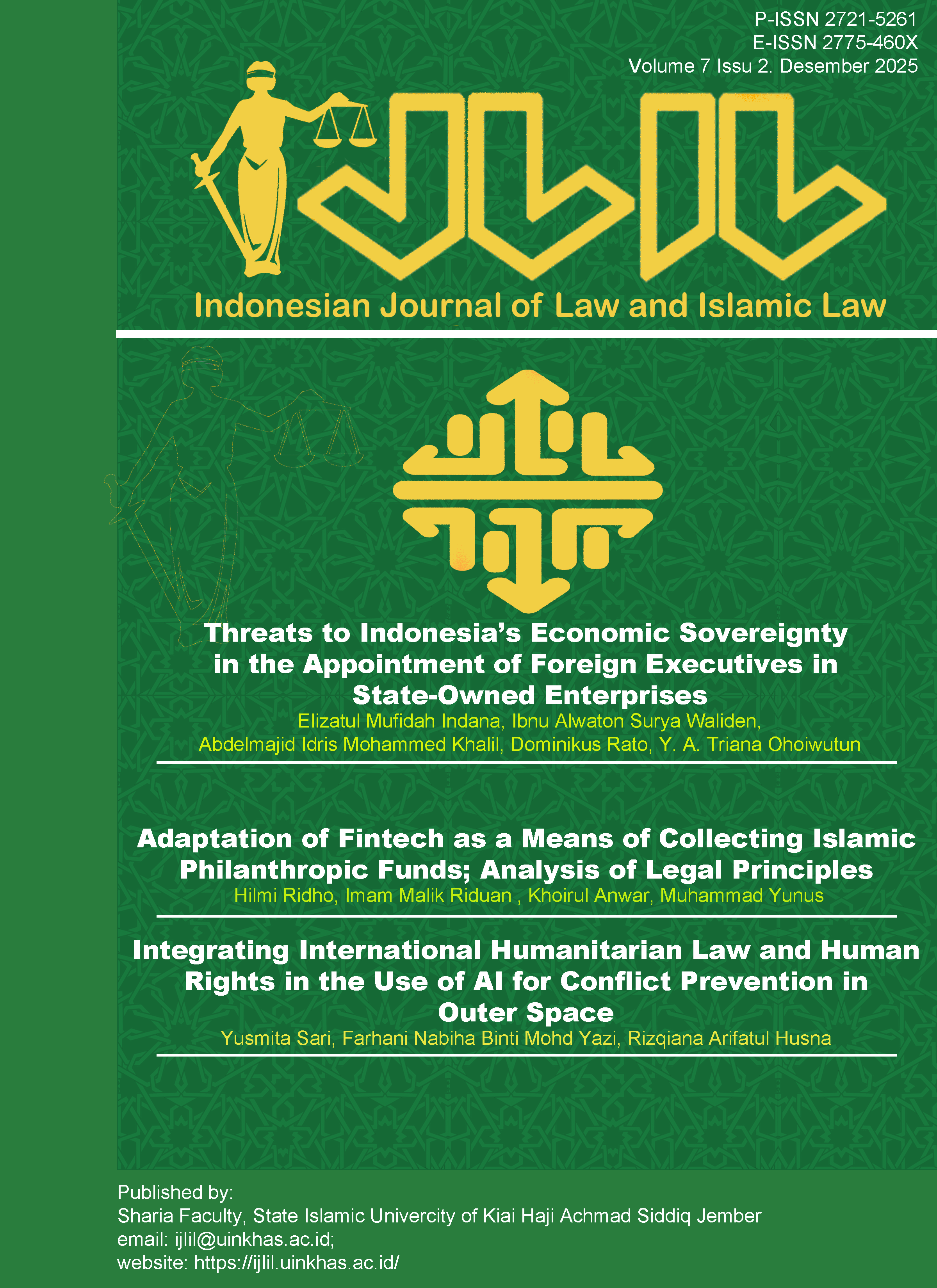
Threats to Indonesia’s Economic Sovereignty in the Appointment of Foreign Executives in State-Owned Enterprises
DOI:
https://doi.org/10.35719/ijlil.v7i2.469Keywords:
SOE, Economic sovereignty, Constitution, CommunityAbstract
This study examines the constitutional implications of the government policy that allows foreign nationals to occupy executive positions in State-Owned Enterprises (SOEs) concerning the principle of national economic sovereignty, as stipulated in Article 33 of the 1945 Constitution of the Republic of Indonesia. The background of this research lies in the growing practice of economic globalization, which demands efficiency and professionalism in SOE management but potentially shifts the meaning of state control over vital sectors of production. This study employs a normative juridical method with conceptual and comparative approaches to national regulations and international practices. The findings indicate that the involvement of foreign nationals in SOE management can be acceptable insofar as it is limited by constitutional principles, the nationality principle, and strict public oversight. The novelty of this research lies in proposing a constitutional policy model that integrates corporate efficiency with state economic sovereignty. This model has practical implications for the international community: positively, it provides a clear legal framework for global investors and professionals, thereby enhancing the predictability of the investment climate and offering an adaptive model for other developing countries to align world-class corporate governance with national sovereignty; however, potentially negatively, strict limitations might be perceived by the global business community as a barrier or discrimination against the transfer of expertise and international capital flows. This integrative approach remains rarely discussed in the field of constitutional economic law in Indonesia.
References
Amik Veteran Journal. “Implementation of Pancasila in Building the National Economy.” Social Science and Communication Journal (SSCJ) 4, no. 2 (2022): 45–59. https://journal.amikveteran.ac.id/index.php/sscj/article/download/5237/3101/15589.
Asshiddiqie, Jimly. Economic Constitution. Jakarta: Penerbit Buku Kompas, 2010.
Butzbach, O. “State-Owned Enterprises as Institutional Actors in Contemporary Capitalism and Beyond.” Cambridge Elements in Law, Economics and Politics. Cambridge University Press, 2021. https://www.cambridge.org/core/elements/stateowned-enterprises-as-institutional-actors-in-contemporary-capitalism-and-beyond/C4764D2F7B31B53E25572736F049A9A7.
Firmansyah, Arif. “Interpretation of Article 33 of the 1945 Constitution in Developing Indonesia’s Economy.” Jurnal Konstitusi 11, no. 4 (2014): 890–891. https://media.neliti.com/media/publications/25286-ID-penafsiran-pasal-33-uud-1945-dalam-membangun-perekonomian-di-indonesia.pdf.
Hadi, S. “The Existence of Pancasila as the Source of All Laws in the Indonesian Constitution.” Indonesian Journal of Law and Islamic Law (IJLIL) 3, no. 2 (2021): 307–320. https://ijlil.iain-jember.ac.id/index.php/ijl/article/download/128/38.
Heo, Kyoungsun. “Effects of Corporate Governance on the Performance of State-Owned Enterprises in Korea.” World Bank Policy Research Working Paper No. 8555. Washington, D.C.: World Bank, 2018. https://documents.worldbank.org/curated/en/523421534424982014/pdf/WPS8555.pdf.
Jurnal Ilmu Pemerintahan (JIP). “Analysis of the Relationship Between National Sovereignty and Economic Independence.” JIP: Jurnal Ilmu Pemerintahan 9, no. 2 (2022): 88–100. https://ojs.co.id/1/index.php/jip/article/view/1338.
Kompas.com. “President: SOEs Must Become World-Class Companies.” Media Republik Indonesia, August 15, 2024. https://www.kompas.com/ekonomi/read/2024/08/15/.
Marzuki, Peter Mahmud. Legal Research. Jakarta: Kencana, 2011.
Milhaupt, Curtis J. “Governance Challenges of Listed State-Owned Enterprises.” Cornell International Law Journal 50, no. 3 (2017): 473–498. https://scholarship.law.cornell.edu/cgi/viewcontent.cgi?article=1907&context=cilj.
Organisation for Economic Co-operation and Development (OECD). State-Owned Enterprises in Asia: National Practices for Performance Evaluation and Management. Paris: OECD Publishing, 2016. https://www.oecd.org/daf/ca/SOEs-Asia-Performance-Evaluation-Management.pdf.
Osman, Fary Akmal. “State-Owned Enterprise (SOE): The Role of SOE Entrepreneurship in Nation-Building Efforts, 1970–2014 (Asia).” The Business History Conference. https://thebhc.org/sites/default/files/Fary_Schwantes_EDITED.%203%20dec%20%28rev%20final%20version%29.pdf.
Pratama, A. T., and M. Zaki. “Ownership Rights of State-Owned Enterprises (SOEs) and Their Relationship with Zakat Obligations.” Neliti. https://www.neliti.com/publications/376823/hak-kepemilikan-badan-usaha-milik-negara-bumn-kaitannya-dengan-kewajiban-zakat-studi-pada-regulasi-zakat-di-. Accessed October 23, 2025.
Rahayu, N. “Efficiency vs. Economic Sovereignty in Indonesian SOEs.” Indonesian Journal of Law and Islamic Law (IJLIL) 7, no. 1 (2025): 21–35. https://ijlil.uinkhas.ac.id/index.php/ijl/article/view/345.
Ratnasari, E. “The Principle of Nationality in the Indonesian Economy.” Indonesian Journal of Law and Islamic Law (IJLIL) 6, no. 2 (2024): 78–90. https://ijlil.uinkhas.ac.id/index.php/ijl/article/view/xyz.
Ruslina, Elli. “The Meaning of Article 33 of the 1945 Constitution in the Development of Indonesia’s Economic Law.” Jurnal Konstitusi 9, no. 1 (2012): 70–72. https://jurnalkonstitusi.mkri.id/index.php/jk/article/view/913.
Soekanto, Soerjono. Introduction to Legal Research. Jakarta: UI Press, 1986.
Sri Edi Swasono. People’s Sovereignty, Economic Democracy, and Social Welfare: Implementation of Articles 33 and 34 of the 1945 Constitution. Jakarta: Gerakan Jalan Lurus, 2008.
The 1945 Constitution of the Republic of Indonesia. Articles 33 (1)–(3).
The Constitutional Court of the Republic of Indonesia. Decision No. 002/PUU-I/2003 and No. 36/PUU-X/2012.
Universitas Katolik Parahyangan. “The Indonesian Economic System in the Perspective of Pancasila and the 1945 Constitution.” Jurnal Veritas et Justitia 7, no. 1 (2021): 65–83. https://journal.unpar.ac.id/index.php/veritas/article/viewFile/3067/2611.
Universitas Sebelas Maret. “State Sovereignty within the Framework of International Law.” Jurnal Yustisia 6, no. 2 (2017): 121–135. https://jurnal.uns.ac.id/yustisia/article/download/10074/8990.
Undang-Undang Republik Indonesia Nomor 19 Tahun 2003 tentang Badan Usaha Milik Negara. State Gazette of the Republic of Indonesia Year 2003 No. 63.
Undip E-Journal System. “People’s Economy vs. Neoliberalism.” Jurnal Gema Keadilan 8, no. 1 (2021): 15–30. https://ejournal2.undip.ac.id/index.php/gk/article/download/3713/2082.
Yusuf, A. The Indonesian Constitution and Economic Sovereignty. Jakarta: Rajawali Pers, 2019.
Downloads
Published
How to Cite
Issue
Section
License
Copyright (c) 2025 Elizatul Mufidah Indana, Ibnu Alwaton Surya Waliden, Abdelmajid Idris Mohammed Khalil, Dominikus Rato, Y.A. Triana Ohoiwutun

This work is licensed under a Creative Commons Attribution-ShareAlike 4.0 International License.