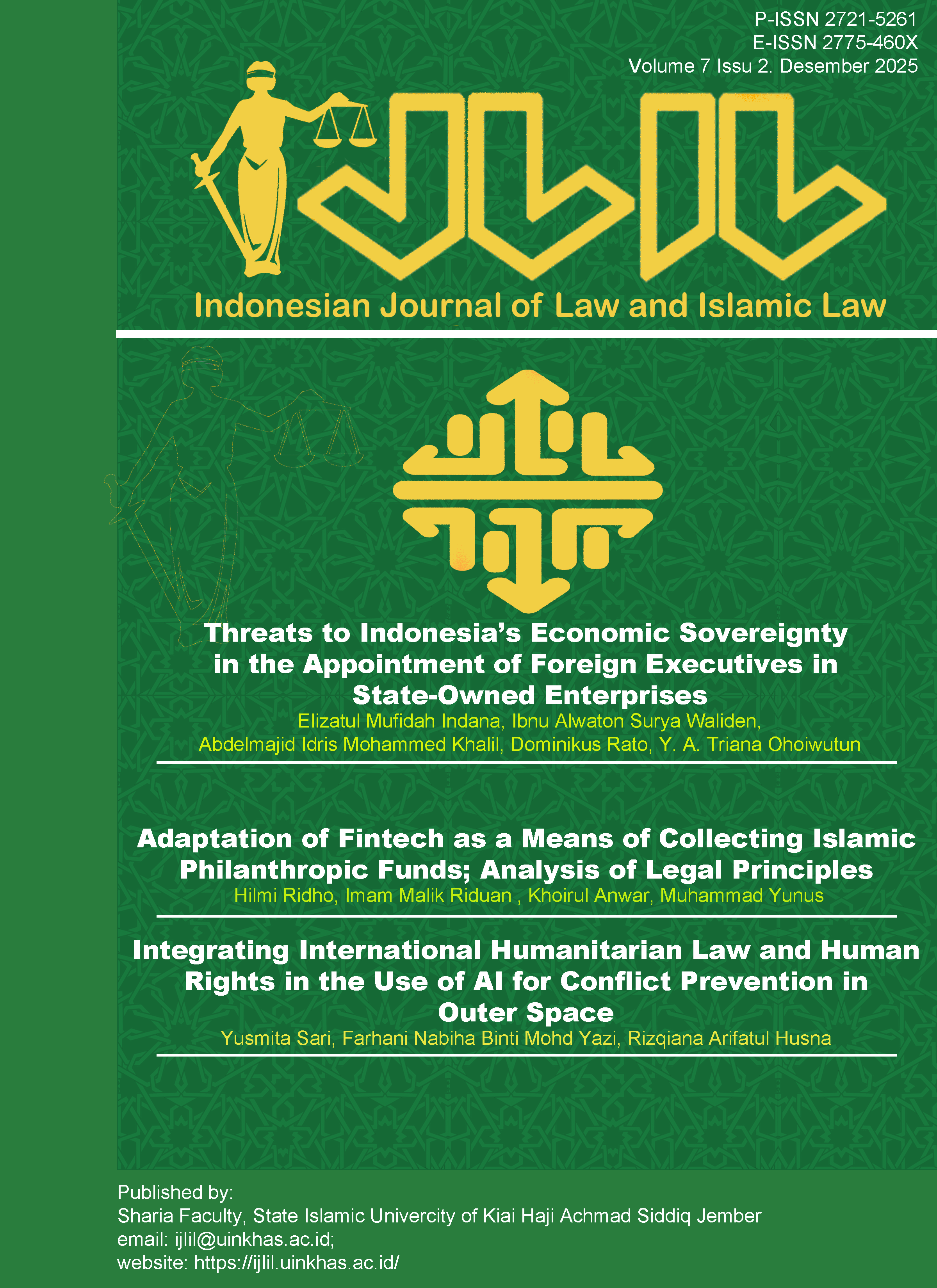
Integrating International Humanitarian Law and Human Rights in the Use of AI for Conflict Prevention in Outer Space
DOI:
https://doi.org/10.35719/ijlil.v7i2.466Keywords:
International, Humanitarian Law, Artificial Intelligence, Space DebrisAbstract
The rapid increase of space debris and the accelerating use of anti-satellite (ASAT) weapons have generated complex legal challenges that threaten orbital sustainability, global security, and civilian infrastructure. This study examines how International Humanitarian Law (IHL) can be integrated into the governance of artificial intelligence (AI) used in space debris management as a preventive mechanism against the escalation of armed conflict in outer space. Using a normative juridical method supported by textual, comparative, and case-study analyses, this research evaluates key international legal instruments including the Outer Space Treaty (1967) and Additional Protocol I (1977) alongside case studies of the 2007 Chinese and 2021 Russian ASAT tests. The findings demonstrate that the IHL principles of distinction, proportionality, and precaution can be operationalized into AI algorithms to enhance object identification accuracy, minimize civilian harm, and reduce the risk of inadvertent conflict. This study identifies critical governance gaps, particularly in the ambiguous interpretation of “peaceful use,” weak verification mechanisms, and the absence of accountability structures for AI-driven orbital activities. The research contributes a novel framework for embedding IHL into AI design parameters, positioning AI not merely as a technological tool but as a strategic legal instrument for safeguarding orbital stability. Strengthening international space law through transparency norms, AI verification protocols, and updated treaty provisions is therefore essential to ensure outer space remains a peaceful and sustainable global commons for future generations.
References
Allard, F. “Artificial intelligence and space.” Journal of Legal, Ethical and Regulatory Issues 25, no. 43S (2022).
Bombardelli, Claudio, dan Jesus Peláez. “Ion beam shepherd for contactless space debris removal.” Journal of Guidance, Control, and Dynamics 34, no. 3 (2011): 916–920.
Claudya, Ribqha, dan Irawati Handayani. “The Challenges of Environmental Protection in Outer Space Following Russia’s Anti-Satellite (ASAT) Weapon Test Activities.” Yustisia 13, no. 2 (2024): 210–229.
Crescent, Red. “International humanitarian law and the challenges of contemporary armed conflicts.” International Review of the Red Cross 106, no. 927 (2024): 1357–1450.
DEBLOIS, BRUCE M. “The Advent of Space Weapons.” Astropolitics 1, no. 1 (2003): 29–53.
Ed. Siregar, El Renova, Adya Paramita Prabandari, dan Naek Siregar. “International Law Review Of Space Debris Mitigation Efforts.” International Journal of Educational Research & Social Sciences 5, no. 2 (2024): 217–223.
ESA Space Debris Office. “ESA 2025 Annual Space Environment Report,” no. 9.0 (2025): 1–144.
Fida Hussain. “The role of Artificial Intelligence in Early Warning System for Violent Conflicts: Explores how technology can predict and prevent Violence, a cutting edge, and interdisciplinary angle.” Advance Social Science Archive Journal 03, no. 02 (2025): 1961–1970.
Hobe, Stephan. A. Treaty on Principles Governing the Activities of States in the Exploration and Use of Outer Space, including the Moon and Other Celestial BodiesUnited Nations, Treaty Series, vol. 610, No. 8843. Space Law, 2019.
Hurova, Anna. “The Nuances of Responsibility of Artificial Intelligence for Irresponsible Space Activity.” Philosophy and Cosmology 32 (2024): 27–33.
Kakkar, Ashish. “Safeguarding orbital sustainability: addressing ai-driven satellite de-orbiting by non-state actors under international law.” Journal on Innovation and Sustainability RISUS 16, no. 2 (2025): 124–134.
Kelso, T.S. “Analysis of the 2007 Chinese ASAT Test and the Impact of its Debris on the Space Environment.” Advanced Maui Optical and Space Surveillance Technologies (2007): 321–330. http://www.m.celestrak.com/publications/AMOS/2007/AMOS-2007.pdf.
Kessler, Donald J, dan Burton G Cour-palais. “Was Observed” 83, no. 8 (1978): 918–924.
Kessler, Donald J, Nicholas L Johnson, dan Mark Matney. “The Kessler Syndrome: Implicatinos to Future Space Operation.” 33rd Annual AAS Guidance and Control Conference 137 (2010): AAS 10-016.
Khalid, Munazza. “Space Legal Regimes, Militarization, and Weaponization of Outer Space.” Astropolitics 19, no. 1–2 (2021): 128–144. https://doi.org/10.1080/14777622.2021.2008768.
Lohani, Ritanshu, dan Luiza Delaflora Cassol. “2024 Outer Space Security Conference Report,” no. September (2024): 1–38. https://unidir.org/wp-content/uploads/2025/01/unidir_2024_outer_space_security_conference_report.pdf.
Murray, James, Tim Kennedy, dan Mark Matney. “Observations of Small Debris from the Cosmos 1408 Anti-Satellite Test using the HUSIR and Goldstone Radars” (2022): 1–10. www.amostech.com.
Nations, United. Ensuring Responsible Ai In Space And Earth Observation. Office For Outer Space Affairs, 2025.
Olugbade, Olajide. “In search of a global governance mechanism for Artificial Intelligence (AI): a collective action perspective.” Global Public Policy and Governance 5, no. 2 (2025): 139–161. https://doi.org/10.1007/s43508-025-00113-z.
Pagallo, Ugo, Eleonora Bassi, dan Massimo Durante. “The Normative Challenges of AI in Outer Space: Law, Ethics, and the Realignment of Terrestrial Standards.” Philosophy and Technology 36, no. 2 (2023): 1–23. https://doi.org/10.1007/s13347-023-00626-7.
Pardini, Carmen, dan Luciano Anselmo. “Evaluating the impact of space activities in low earth orbit.” Acta Astronautica 184, no. April (2021): 11–22. https://doi.org/10.1016/j.actaastro.2021.03.030.
Pritchard, Suzanne. “The final frontier.” International Water Power and Dam Construction 65, no. 12 (2013): 18–19.
Schindler, Dietrich, dan Jiri Toman. “Protocol Additional to the Geneva Conventions of 12 August 1949, and Relating to the Protection of Victims of International Armed Conflicts (Protocol I).” The Laws of Armed Conflicts, no. August (2021): 711–773.
Schmitt, Michael N. “International Humanitarian Law and the Targeting of Non-State Intelligence Personnel and Objects.” Duke Journal of Comparative & International Law 30, no. 2 (2020): 309–346.
Semenyaka, Vasyl. “International-Legal Problem of Space Debris.” Advanced Space Law 1 (2018): 84–90.
Stonis, Danylo. “Ambiguities in Space Law as Path towards Weaponization of Space: the Case of the Outer Space Treaty. Remarks on Regulation of Weaponization of Outer Space by Space Law.” Copernicus Political and Legal Studies 1, no. 4 (2022): 74–84.
Uçkaç, Mehmet. “Examining the Use of Artificial Intelligence in Space Technologies , Taking Into Account the Dimensions of International Law.” Luminis Applied Science and Engineering 2, no. 3 (2025): 66–80.
United Nations. United Nations Treaties and Principles on Space Law. Office For Outer Space Affairs, 1967. http://www.oosa.unvienna.org/oosa/SpaceLaw/treaties.html.
Downloads
Published
How to Cite
Issue
Section
License
Copyright (c) 2025 Yusmita Sari, Farhani Nabiha Binti Mohd Yazi, Rizqiana Arifatul Husna

This work is licensed under a Creative Commons Attribution-ShareAlike 4.0 International License.