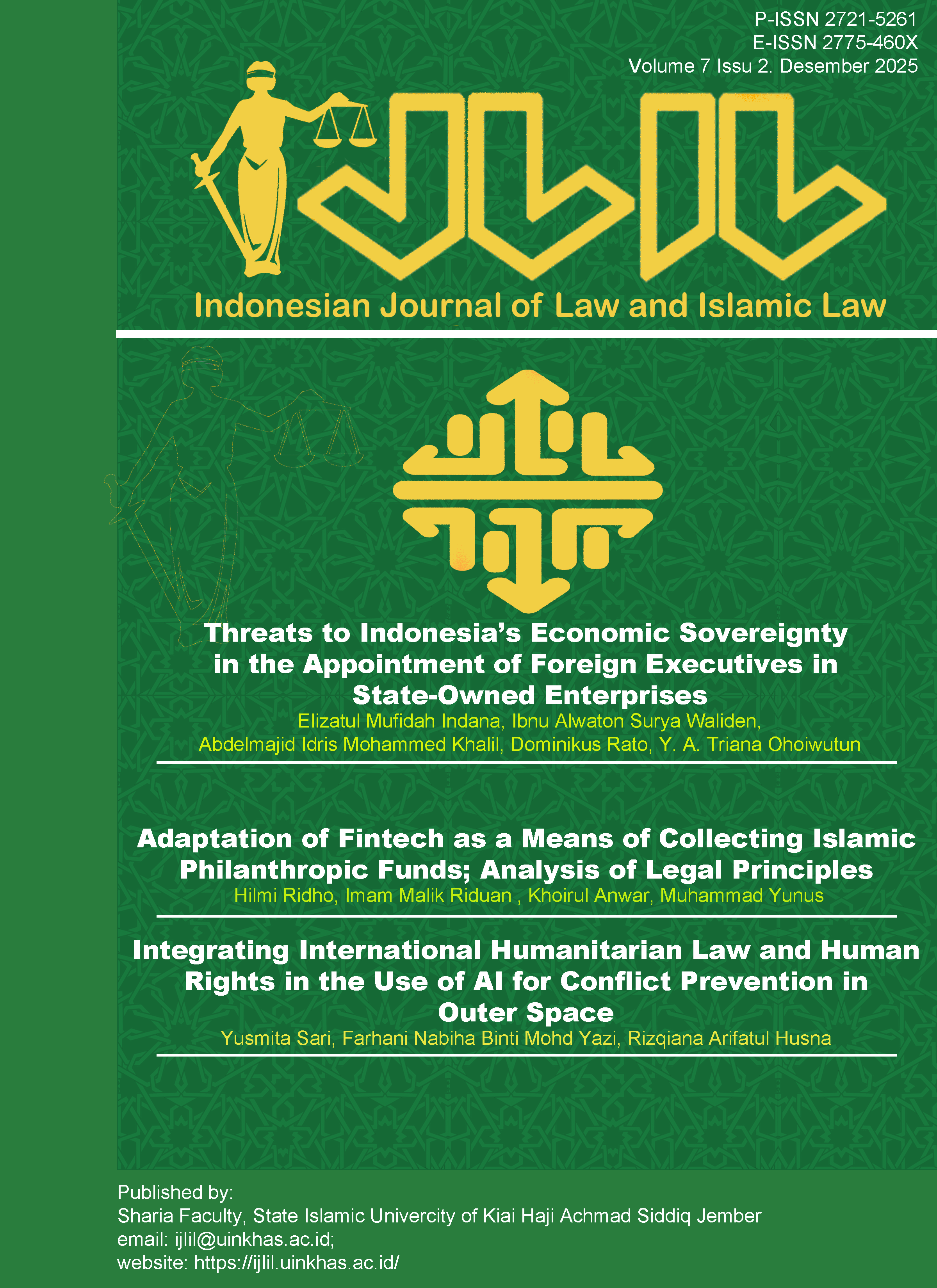
Adaptation of Fintech as a Means of Collecting Islamic Philanthropic Funds; Analysis of Legal Principles
DOI:
https://doi.org/10.35719/ijlil.v7i2.461Keywords:
Fintech, Money, Digital Platform, ZakatAbstract
The development of financial technology (fintech) has significantly transformed financial transactions from cash-based to non-cash systems. In Indonesia, the widespread use of technology highlights the growing importance of fintech across various sectors, including the collection of Islamic philanthropic funds such as Zakat, Infak, and Sedekah (ZIS). This study aims to analyze the payment of ZIS funds through digital platforms from the perspective of applicable legal principles. It also examines the legal status of zakat on money in Islamic law and the permissibility of paying zakat in monetary form. This research employs a normative legal method using conceptual and historical approaches, analyzed through deductive reasoning. The findings indicate that the majority of Islamic scholars and religious institutions agree on the obligation of zakat on money once its value reaches the nisab equivalent to gold or silver and fulfills the haul requirement. This view is based on the role of money as the primary indicator of wealth in the modern era. Hadiths that mention zakat obligations in the form of livestock or agricultural products are interpreted as referring to the value (qīmah) rather than the physical object (`ain). Furthermore, the use of fintech in ZIS fund collection is considered permissible as long as it complies with Sharia principles and avoids harmful elements. Digital technology in ZIS collection aligns with the principle of ḥifẓ al-māl (protection of wealth) by enhancing efficiency and expanding outreach. In cases of failed online zakat transactions, responsibility is determined based on negligence by the muzaki, zakat institution, or service provider. Such failures do not nullify the zakat obligation, which remains the responsibility of the muzaki to fulfill.
References
A`yun, Putri Qurrata, and Dzulkifli Hadi Imawan. “Sahal Mahfudh’s Thoughts On Social Fiqh And The Implementation Of Productive Zakat.” Ijtihad: Jurnal Hukum dan Ekonomi Islam 16, no. 1 (2022): 19–39.
Abdelkader, Osama Ahmed. “Significant Concerns Influence Online Pro Bono Volunteering of Faculty Members.” Computers in Human Behavior 73, no. 8 (2017): 547–553.
Ahmad Ar-Raysuni. Nadhariyatu Al-Maqashid ‘Inda Al-Imam Asy-Syatibi. Beirut: al-Ma’had al-Alami, li al-Fikr al-Islamiy, 1990.
Al-Anshāri, Zakariyyā. Ghāyat Al-Wushūl Syarh Lubb Al-Ushūl. Semarang: Maktabah Hidayah, 2000.
Al-Bukhāri, Muḥammad ibn Isma’īl. Ṣaḥīḥ Bukhāri. Maroko: Dār Thuq an-Najah, 2005.
Al-Hanafi, Abu Bakr Ibn Mas’ud Al-Kasani. Badāi’ Al-Ṣanāi’ Fi Tartīb Al-Syārai’. Beirut: Dar al-Fikr, 1996.
Al-Jauziyyah, Ibnu al-Qayyim. I’lām Al-Muwaqqi’īn ‘an Rabb Al-‘Ālamīn. Beirut: al-Maktabah al-‘Aṣriyyah, 2004.
Al-Jāwi, Muhammad ibn Umar. Nihayah Al-Zain Fi Irsyadi Al-Mubtadiin. Beirut: Dar al-Fikr, 2001.
Al-Nadawi, ‘Ali Ahmad. Al-Qawā’id Al-Fiqhiyyah; Mafhūmuhā Wa Nasy‘atuhā Wa Tathawwuruhā Wa Dirāsat Muallifatihā Wa Adillatuhā Wa Muhimmatuhā Wa Tathbīquhā. Damaskus: Dār al-Qalam, 1994.
Al-Nawawi, Muhyiddin Yahya bin Syaraf. Al-Majmu’ Syarh Muhadzdzab. Jeddah: Maktabah al-Irsyad, 1999.
Al-Qardlawi, Yusuf. Al-Ijtihad Fi Al-Syari’at Al-Islamiyah Ma’a Nazharat Tahliliah Fi Al-Ijtihad Al-Mua’shir. Kuwait: Dar al-Qalam, 1985.
———. Fiqh Al-Zakah; Dirasah Muqaranah Li Ahkamiha Wa Falsafatiha Fi Daw’ Al-Qur’an Wa Al-Sunnah. Beirut: Muasasah ar-Risāslah, 1991.
———. Syari‘ah Al-Islam Salihah Li Al-Tatbiq Fi Kulli Zaman Wa Makan. Kairo: Dar al-Sahwah, 1993.
Al-Sarakhsi, Muhammad bin Ahmad. Al-Mabsuth. Beirut: Dar al-Makrifah, 1993.
Al-Syāfi’i, Muḥammad ibn Idrīs. Al-Umm. Baerut Lebanon: Dār al-Ma’rifah, 1990.
Al-Utsaimin, Muhammad bin Shalih. Syarh Al-Mumti’ `Ala Zad Al-Mustaqni’. Arab Saudi: Dar Ibn al-Jauzi, 2001.
Al-Zuhaily, Muhammad Mustafa. Al-Qawāid Al-Fiqhiyyah Wa Taṭbīqātuhā `Alā Al-Mażāhib Al-Arba`ah. Damaskus: Dar al-Fikr, 2006.
Al-Zuhaily, Muhammad Musṭafa. Al-Wajīz Fi Uṣūli Al-Fiqh. Beirut: Dār al-Khair, 1997.
Al-Zuhaily, Wahbah. Al-Fiqh Al-Islām Wa Adillatuhu. Suriah: Dār al-Fikr, 2004.
———. Mausū`ah Al-Fiqh Al-Islamī Wa Al-Qaḍāyā Al-Mu`āsirah. 3rd ed. Damaskus: Dar El-Fikr, 2012.
Ash-Shidieqy, Muhammad Hasbi. Pedoman Zakat. Semarang: PT. Pustaka Rizki Putra, 1996.
Asosiasi FinTech Indonesia (AFTECH). Indonesia Fintech 2025 Report: Past Lessons and Future Opportunities. Indonesia, 2025.
Asy-Syuyuthi, Jalaluddin. Al-Ashbah Wa An-Nadzair Fi Al-Furu’. Semarang: Toha Putra, 1991.
Baz, Abdul Aziz bin Abdullah bin Abdurrahman bin. Majmū` Fatāwā Wa Maqālāt Mutanawwi`ah. Riyadh: Riyasah Idarah al-Buhuts al-Ilmiyah wa al-Ifta’, 2003.
Beik, Irfan Syauqi, Muhammad Hasbi Zaenal, and Abdul Aziz Yahya Saoqi. “The Optimization of Blockchain for Greater Transparency in Zakat Management.” In Islamic FinTech: Insights and Solutions, edited by Mohd. Ma`sum Billah, 281–297. Arab Saudi: Palgrave Macmillan Springer, 2021.
Ḥajjāj, Muslim. Ṣaḥīḥ Muslim. Lebanon: Dār al-Kutub al-Ilmiyah, 2011.
Kailani, Najib, and Martin Slama. “Accelerating Islamic Charities in Indonesia: Zakat, Sedekah and the Immediacy of Social Media.” South East Asia Research 28, no. 1 (2020): 70–86.
Karimullah, Suud Sarim. “Agus Moh. Najib’s Project and Ushul Fiqh Redesign: Interlinking of Islamic Law and Legal Sciece.” Al-Mazaahib: Jurnal Perbandingan Hukum 11, no. 2 (2023): 139–159.
Khallāf, ’Abdul Wahhāb. ‘Ilmu Uṣūl Al-Fiqh. Mesir: Maktabah Dakwa Islamiyah, 2010.
Kharisma, Dona Budi. “Urgency of Financial Technology (Fintech) Laws in Indonesia.” International Journal of Law and Management 63, no. 3 (2021): 320–331.
Lembaga Bahtsul Masail PBNU. Keputusan Muktamar Nahdlatul Ulama (NU) Ke-8. Jakarta, 1933.
Marzuki, Peter Mahmud. Penelitian Hukum. Jakarta: Kencana Prenada Group, 2007. https://books.google.co.id/books?id=CKZADwAAQBAJ&printsec=copyright#v=onepage&q&f=false.
Masrifah, Atika Rukminastiti, and Fajrin Intan Safitri. “The Impact of Zakat on Money Demand Function: Evidence From Muzakki in Indonesia.” Jurnal Ekonomi dan Bisnis Islam (Journal of Islamic Economics and Business) 7, no. 2 (2021): 308–326.
Maulida, Sri, Fahmi Al Amruzi, Budi Rahmat Hakim, and Irfan Syauqi Beik. “Post-Pandemic Digital Transformation in Zakat Management: Insights From Maqāṣid Syari’ah in South Kalimantan.” El-Mashlahah 14, no. 2 (2024): 281–302.
Muhajir, Afifuddin. Membangun Nalar Islam Moderat: Kajian Metodologis. Situbondo: Tanwirul Afkar, 2018.
Piliyanti, Indah, Hilman Latief, and Syamsur Anwar. “Technologizing Islamic Philanthropy During The Covid-19 Pandemic in Indonesia.” Journal of Muslim Philanthropy and Civil Society 6, no. 2 (2022): 120–141. https://scholarworks.iu.edu/iupjournals/index.php/muslimphilanthropy/article/view/4911.
Pradja, Juhaya S. Ekonomi Syariah. Bandung: CV. Pustaka Setia, 2012.
Rachman, M. Aulia, and Annisa Nur Salam. “The Reinforcement of Zakat Management through Financial Technology Systems.” International Journal of Zakat 3, no. 1 (2018): 57–69.
Ridho, Hilmi. “Pemberdayaan Ekonomi Masyarakat Berbasis Zakat Komunitas Perspektif Maqashid As-Syariah Ibnu Asyur (Studi Kasus Di BAZNAS Kab. Jember).” Proceedings of Islamic Economics, Business, and Philanthropy 1, no. 2 (2022): 656–679.
Ridho, Hilmi, Hamim Maftuh Elmi, and Muhammad Sibawaihi. “Fiqh Al-Aqalliyat; Jurisprudence For Muslim Minorities As A Guide To Living In Non-Muslim Countries.” Syariah: Jurnal Hukum dan Pemikiran 23, no. 1 (2023): 93–106.
Ridho, Hilmi, Aizat Khairi, Abdul Mujib, and Sageer Ahmed. “Adaptation of Siyasah Fiqh as a Strategy to Prevent Money Politics in Elections.” Indonesian Journal of Law and Islamic Law (IJLIL) 6, no. 2 (2024): 30–49.
Ridho, Hilmi, Ali Sodiqin, and Abdul Mujib. “The Evolution of Islamic Philanthropy in Indonesia’s Digital Age (2016–2023).” Al-Ahkam 35, no. 1 (2025): 31–58.
Ridho, Hilmi, and Abdul Wasik. Zakat Produktif; Konstruksi Zakatnomics Perspektif Teoretis, Historis, Dan Yuridis. Edited by Fauzan Adhim. 1st ed. Malang: Literasi Nusantara, 2020.
Sābiq, Sayyid. Fiqh Al-Sunnah. Beirut: Dār al-Fikr, 1985.
Sarwat, Ahmad. Zakat Uang. Edited by Fatih. Jakarta: Rumah Fiqih Publishing, 2019.
Setiawan, Budi, Deni Pandu Nugraha, Atika Irawan, Robert Jeyakumar Nathan, and Zeman Zoltan. “User Innovativeness and Fintech Adoption in Indonesia.” Journal of Open Innovation: Technology, Market, and Complexity 7, no. 3 (2021): 1–18.
Tedjo, Sasongko. Dialog Dengan KH. Sahal Mahfudh: Telaah Fiqh Sosial. Semarang: Yayasan Karyawan Suara Merdeka, 1997.
Triantoro, Dony Arung, Tri Wahyuni, and Fitra Prasapawidya Purna. “Digital Philanthropy: The Practice of Giving Among Middle To Upper-Class Muslim in Indonesia and Soft Capitalism.” Qudus International Journal of Islamic Studies (QIJIS) 9, no. 2 (2021): 315–350.
Downloads
Published
How to Cite
Issue
Section
License
Copyright (c) 2025 Hilmi Ridho, Aizat Khairi, Khoirul Anwar, Muhammad Yunus

This work is licensed under a Creative Commons Attribution-ShareAlike 4.0 International License.